The Probing Company is a Geoprobe® Direct Push Drilling Service company located in Atlanta, Georgia. We conduct Geoprobe® Direct Push drilling in Georgia, Alabama, Tennessee, Mississippi, Florida, Louisiana, North Carolina and South Carolina.
Soil Sampling
The Probing Company is qualified to complete any and all direct push soil sampling at your job site. Our Geoprobe® Direct Push Services/Direct Push Drilling doesn’t generate soil cuttings like typical augering methods, and is well known throughout the environmental industry as the fastest and most economical way to collect soil samples from a site. The Probing Company utilizes the Geoprobe® MacroCore™ Sampling System, Geoprobe® DualTube™ Sampling System, and the Geoprobe® LargeBore™ Sampling System to collect soil samples as part of our Geoprobe® Direct Push Services.
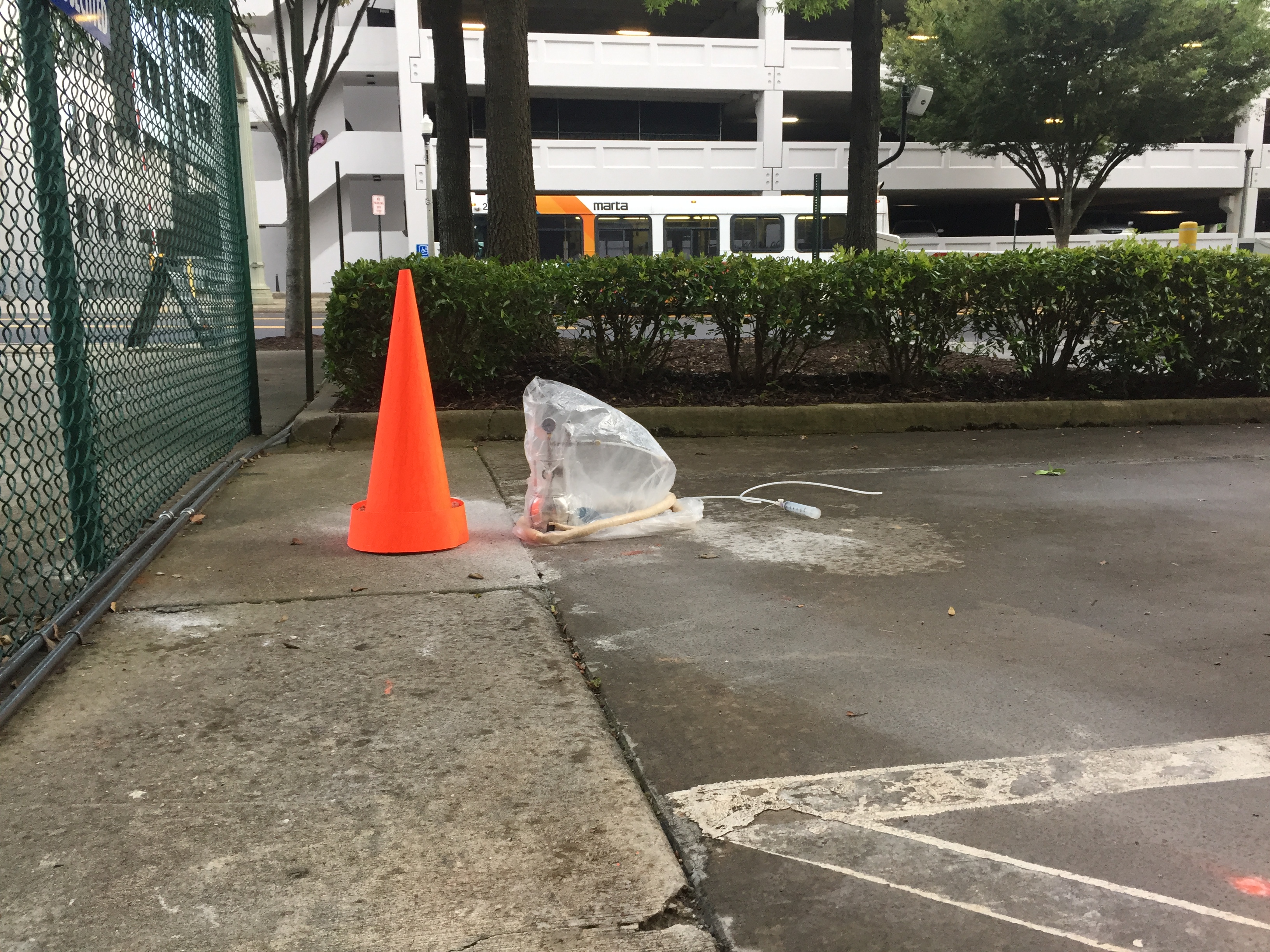
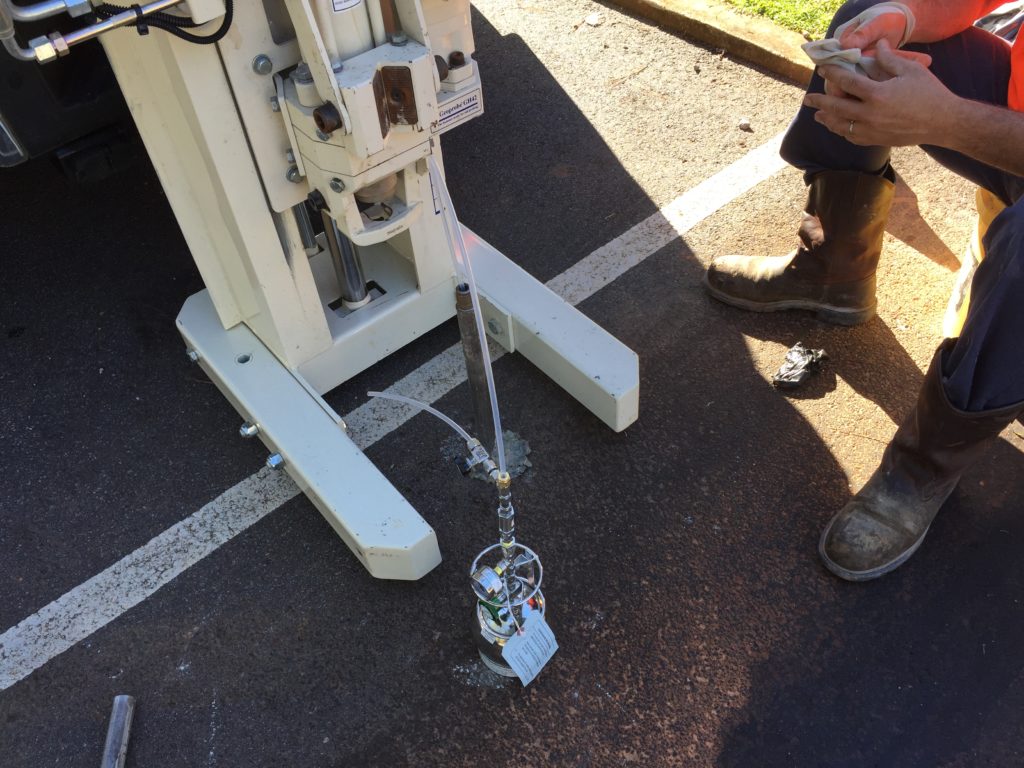
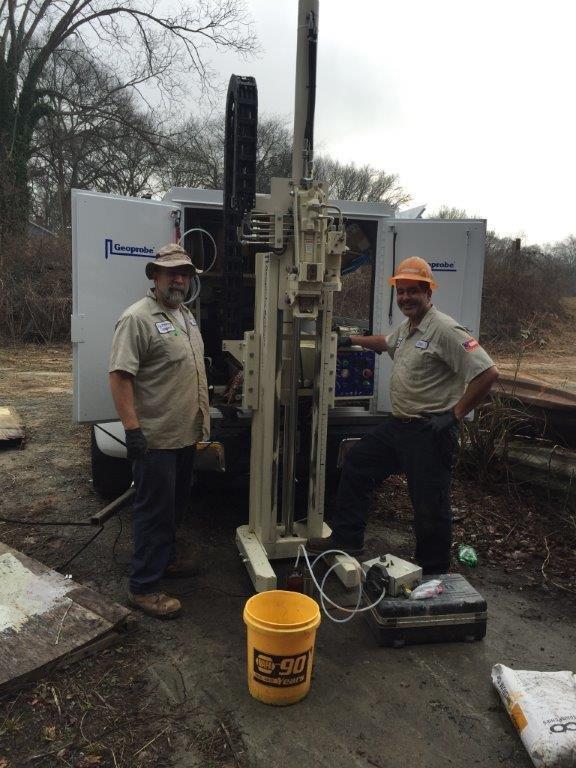
Installing a shallow soil gas soil vapor sampling point in Atlanta, Georgia

MacroCore Sampling System
The Geoprobe® MacroCore™ Sampling System utilizes a 4-foot long soil sampler that collects soil core samples from unconsolidated subsurface materials. These unconsolidated materials may include soils, sediments and waste materials, or a mixture of all three. This sampler works best in medium to fine grained soils such as silty clays. When a sand catcher is used, the MacroCore™ sampler works well in fine to medium grained sands and gravels as well as flowing sands. There are two options to consider when using the Geoprobe® MacroCore™ sampling system: Open Tube or Closed Piston.
Steep Slope Geoprobe Drilling in Birmingham, Alabama

DualTube Sampling System
The Geoprobe® DualTube™ Sampling System is the sampling system of choice for The Probing Company. This system utilizes Geoprobe® 2.25-inch rods assembled with a cutting shoe, and a drive head. The acetate liners are contained inside the large rods and are driven into the subsurface utilizing the percussion of the Geoprobe® rig until the sampler is at the target depth. Once at the target depth, the tooling attached to the PVC sample liner with soils inside are removed from the ground and a new sleeve is placed on the tools and the sampler was lowered back inside the hole to the last depth of penetration. Once at that depth, additional tooling is attached, and the sampler is advanced into the subsurface again using the percussion of the direct push rig. This process is repeated until reaching the target depth.
Organic Vapor Monitoring Instrument for Measuring Organic Vapors in Soil or Air

Open Tube Sampling
The most economical and common use of the Geoprobe® MacroCore™ sampling system is the open tube method. Coring starts at the ground surface with an open ended sampler. The open ended sampler is assembled with a cutting shoe, drive head and the sampling sleeves. The open tube sampler is driven into the subsurface using the percussion of the Geoprobe® rig until the sampler is at the target depth. Once at the target depth, the sampler is removed from the ground, the cutting shoe removed and the sample sleeve extracted with the soil inside. A new sleeve is placed in the sample tube and the sampler and the cutting shoe are replaced. Once together, the entire tool string is advanced beyond the last depth of penetration by adding a drive rod. This procedure is repeated until the sampler reaches the desired target depth.
Prepping the Geoprobe tooling for soil and groundwater sampling.

Closed Piston Sampling
The closed piston system is best suited for unstable soils which tend to collapse or expand into the probe hole. The closed piston system locks a retractable drive point into the cutting shoe and prevents soil from entering the MacroCore™ sampler as it is advanced into the borehole. As a drive rod is added, an inner rod is placed into the center of the drive rod to lock the retractable drive point in place. Within the last four feet of the target depth, a final drive rod is added without the inner rod. This allows the drive point to retract into the MacroCore™ sampler as the sampler is advanced the final four feet. This method allows the soil to be collected into the sleeve from the exact target depth. Removal of the rods and the soil sample are the same as with the open barrel sampling system.
Geoprobe® Large Bore Sampling System
The Geoprobe® LargeBore™ Sampling System utilizes a solid barrel sampling system like the MacroCore™ Sampling System, except that it is smaller in diameter, approximately 30-inches long and utilizes a 22-inch sample sleeve.
The LargeBore™ sampler can be utilized as an open tube sampler or a closed piston sampler. We utilize the Large Bore™ sampler for select limited space interior sampling and difficult location access jobs.
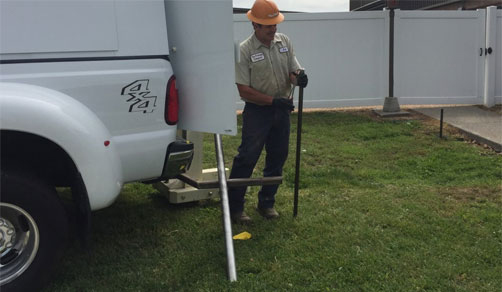
Installing Geoprobe Direct Push Borings in Atlanta, Georgia

Soil Gas Sampling in Birmingham, Alabama

GroundWater sampling
Groundwater sampling from a Geoprobe® rig can be accomplished in many ways. Samples can be collected utilizing the Geoprobe® Screen Point 15/16/22 sampler (SP-15/SP-16/SP-22), installing small diameter temporary monitoring wells or installing permanent monitoring wells.



Temporary and Permanent Monitoring Wells
Both temporary and/or permanent monitoring wells can be installed with the Geoprobe® rig. We install temporary monitoring wells by one of two methods:
- By removing the soil column with a Geoprobe® MacroCore sampler and installing the small diameter slotted PVC screen and well pipe into the open borehole to the desired depth; or
- By advancing Geoprobe® 2.25-inch rods fitted with an expendable drive point to the target depth and inserting the screen and casing in the open rods. Once the screen and well pipe are threaded together and placed inside the rods, the steel casing is removed from the subsurface while holding the temporary well in place. The groundwater is extracted from these wells using disposable poly tubing and a peristaltic pump or a stainless steel check ball valve.
Permanent monitoring wells are also installed using Geoprobe® 2.25-inch rods that are fitted with an expendable drive point in a similar fashion to the temporary monitoring well installation; however, the well screen is wrapped in stainless steel mesh filled with sand (pre-pack well screen). This aids in well development and sampling by ensuring that a sand filter media is uniformly placed around the well screen. Once the well is in place at the bottom of the rods, additional sand is added to the rods to raise the sand level by two feet on the top of the pre-pack well screen.
A two foot thick bentonite seal is then placed on top of the sand and the rods are extracted from the subsurface. The annulus is then filled to the surface with a grout slurry. Permanent wells are typically completed with either a flush-mounted vault or a stand-up well cover.
Soil Gas Sampling
Soil gas sampling is increasing in frequency across the country as vapor intrusion continues to gain regulatory attention. When evaluating the potential for vapor intrusion at a particular site, it is useful to collect soil gas samples to find out how vapors and contaminants of concern are migrating in the subsurface, and whether or not those vapors are migrating indoors. Soil gas sampling, used in conjunction with screening criteria and/or modeling, is often an intermediate step between screening based on groundwater concentration and collecting indoor air samples.
The goal of soil gas sampling is to collect a sample of the vapor that resides in the interstitial soil pores near a source of contamination and/or near a receptor. To sample soil gas, a temporary or permanent soil vapor probe is installed to facilitate the collection of a sample of the soil gas. Soil gas sampling can be completed with hand tools or with a Geoprobe® rig.
Soil Gas Sampling Inside an Active Dry Cleaner

Sub Slab Soil Gas Sampling - Hand Tools
Sampling with hand tools is the fastest and most economical way to sample sub slab soil gas. It doesn’t require a Geoprobe® rig, and the borings can easily be abandoned after use.
The following describes a typical method for collecting sub slab soil gas samples:

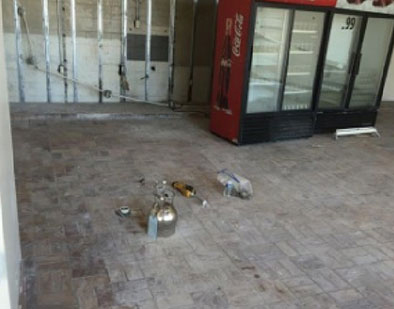

- A 5/8-inch pilot hole is drilled through the concrete surface to a depth of approximately 2 to 3 inches below the slab.
- Once the hole was drilled, a bottle brush is used to clean the concrete dust from the boring.
- With the hole brushed clean, a dry-vac is utilized to clean the brushed and drilled cuttings from the surface and vapor surface attachment is inserted inside the hole and hammered into place;
- With the vapor surface attachment in-place, a water dam is set over the boring and sealed with the surface;
- De-ionized water inside the water dam to test the tightness of the seal with the vapor surface attachment and the concrete surface;
- Once the seal is confirmed, Teflon® or nylon tubing is connected to the vapor surface attachment;
- With the tubing connected, a Summa® canister or tedlar bag is connected to the tubing and allowed to set undisturbed until the testing is complete; and
- After completion of the test, the vapor surface attachment is removed from the surface, and the hole is abandoned and patched to match the existing surfacing material. Although more costly to install, permanent vapor monitoring points can also be installed by this method.
Geoprobe® Direct Push Services = The Probing Company!
Soil Gas Sampling - Geoprobe® Rig
Soil gas samples can be collected at any depth using the Geoprobe® Post Run Tubing System (PRT System). To facilitate the collection of the soil gas sample, a steel expendable point is placed in an expendable point holder that is attached directly to a drive rod. Once attached, the drive rod is driven to the target depth. The drive rod and expendable point holder are retracted and the steel expendable point is separated from the point holder thus creating a void beneath the drive rods in the soil. An adapter and tubing are advanced down the inside of the drive rods and threaded to the point holder. The tubing at the surface is attached to a pumping system to purge the line and draw a sample.
Most applications utilize Teflon® or nylon tubing; however, other materials can be utilized if desired. Once the line has been purged, samples are typically collected in a Tedlar bag or Summa® canister.
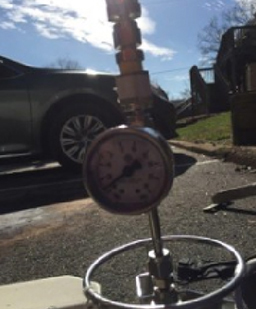
Helium Leak Testing a Soil Gas Sampling Point in Decatur, Georgia